
How Energy Market Volatility Is Driving Local Print Production
Why Companies Are Printing Marketing Materials Closer to Where They Are Needed
In today’s global economy, energy costs are no longer stable or predictable. Fluctuations in oil prices, fuel shortages, geopolitical tensions, and shifting energy policies are having a direct impact on transportation and logistics costs worldwide.
For companies that rely on printed materials—whether for marketing, events, packaging, or operations—these changes are creating new challenges. Rising fuel costs are increasing the price of shipping, extending delivery timelines, and adding uncertainty to global supply chains.
As a result, many organizations are rethinking their approach to print production. One of the most effective strategies emerging from this shift is producing printed materials closer to where they are needed.
Local and near-shore print production is becoming a practical way for companies to manage costs, reduce risk, and maintain control over their marketing and operational materials.
The Link Between Energy Costs and Print Logistics
Energy costs play a central role in global logistics. When fuel prices rise, transportation costs increase across every mode of shipping:
air freight becomes more expensive
ocean shipping rates increase
trucking costs rise
last-mile delivery expenses grow
For printed materials, which are often heavy and shipped in bulk, these cost increases can be significant.
A shipment of brochures, catalogs, or event materials that once seemed affordable to transport internationally may now carry a much higher price tag.
This is leading companies to take a closer look at how far their materials are traveling—and whether that distance is necessary.
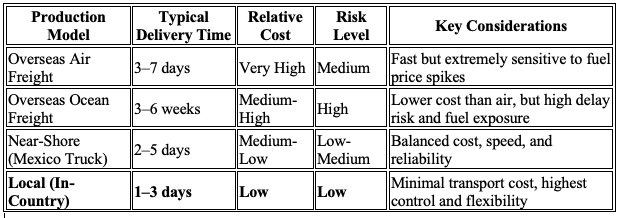
Why Local Print Production Reduces Energy-Driven Costs
Producing printed materials closer to the destination market reduces dependence on long-distance transportation. This has a direct impact on cost and reliability.
Lower Transportation Costs
When materials are printed locally or near-shore, they require less fuel to reach their destination. Instead of relying on international air or ocean freight, companies can use regional or domestic transportation.
This shift can significantly reduce overall logistics expenses.
More Predictable Delivery Timelines
Energy market volatility often leads to fluctuations in shipping availability and pricing. Carriers may adjust routes, limit capacity, or increase rates with little notice.
By shortening the distance between production and delivery, companies gain more control over their timelines and reduce exposure to these disruptions.
Reduced Exposure to Fuel Price Spikes
When materials are shipped long distances, transportation costs are directly tied to fuel prices. Sudden increases in energy costs can quickly inflate logistics budgets.
Local print production minimizes this exposure by reducing the reliance on fuel-intensive shipping methods.
The Impact on Marketing and Operations
For marketing teams and operations managers, the effects of rising energy costs are becoming more visible.
Campaign budgets are under pressure as shipping costs increase. Timelines are harder to predict, making it more difficult to coordinate product launches, events, and promotions.
By adopting local print production strategies, companies can maintain greater control over both cost and timing.
Local and Near-Shore Printing as a Strategic Solution
For U.S. companies, near-shore printing in Mexico, as an example, offers a practical way to balance cost efficiency with speed.
Mexico’s proximity allows companies to reduce transportation distances while still benefiting from competitive production capabilities.
Key advantages include:
faster delivery across North America
reduced reliance on air freight
lower fuel-related transportation costs
more stable and predictable logistics
Near-shoring provides many of the benefits of local production while maintaining scalability for larger print volumes.
For companies needing print in far-away places, printing in-country makes perfect sense, both for the economics and peace of mind, especially in volatile energy and financial climates.
Supporting Sustainability Goals
Energy consumption is closely tied to environmental impact. As companies work toward sustainability targets, reducing transportation emissions has become a priority.
Producing printed materials closer to the end market helps reduce:
fuel consumption
carbon emissions
packaging waste associated with long-distance shipping
Local and near-shore printing align with broader corporate sustainability initiatives while also delivering cost benefits.
A Shift Toward Smarter Print Supply Chains
The volatility of global energy markets is accelerating a broader shift in how companies manage their supply chains.
Organizations are moving away from long, complex logistics networks and toward more flexible, regional production models.
In the print industry, this means:
producing materials closer to the point of use
reducing dependence on international shipping
improving responsiveness to changing market conditions
This approach allows companies to operate more efficiently in an environment where costs and conditions can change quickly.
The Future of Print Production in an Uncertain Energy Market
Energy market volatility is unlikely to disappear in the near future. Companies must adapt to a landscape where transportation costs can fluctuate rapidly and unpredictably.
By embracing local and near-shore print production, organizations can reduce risk and maintain greater control over their operations.
Producing printed materials closer to where they are needed is no longer just a cost-saving measure. It is a strategic decision that supports resilience, efficiency, and long-term growth.
For companies managing global marketing and operational materials, local print production offers a practical path forward in an increasingly uncertain world.
What This Means for Your Business
If you're shipping print internationally → your costs are now tied to fuel volatility
If you're printing locally or near-shore → you’ve reduced that exposure dramatically
Final Takeaway
Energy costs are no longer just a background factor in logistics. They are a primary driver of supply chain decisions.
For companies that rely on printed materials, the solution is clear:
Produce closer to the destination
Reduce reliance on fuel-intensive shipping
Adopt local and near-shore print strategies
This approach improves cost control, delivery speed, and overall reliability.